
By Paul Hoyt
Introduction: The Difference Between Voting and Power
A country can have elections and still lose its democracy.
The old image of corruption is too small for the problem we face. We tend to imagine corruption as a secret envelope of cash handed across a table. But modern corruption is often more sophisticated, more legalistic, and more difficult to prove. It can hide inside campaign finance, nonprofit advocacy groups, Super PACs, lobbying contracts, luxury travel, sweetheart loans, speaking invitations, consulting fees, family jobs, and future employment.
It can have candidates, campaigns, slogans, debates, patriotic speeches, and citizens standing in line at polling places – all the outward signs of representative government – and still have real power quietly shifting into the hands of those wealthy enough to buy access, shape policy, fund campaigns, reward loyalty, and punish opposition.
That is how democracy becomes oligarchy. And when the ruling few are the wealthy few, it becomes plutocracy.
Democracy is built on the belief that every person has equal civic worth. It does not mean equal income or equal influence. But it does mean every citizen should count equally in the political life of the country. The problem begins when wealth becomes a private doorway into public power – when a handful of people can use money to gain access, shape legislation, influence appointments, protect loopholes, weaken enforcement, and steer public contracts.
Ordinary people may still get the vote. But the wealthy get the private meeting. They get the fundraiser, the lobbyist, the think tank report, the regulatory carve-out, the tax loophole, the board seat, and the quiet promise of support.
America has not fully lost its democracy. But it would be dishonest to pretend the system is healthy.
Money buys access. Access shapes policy. Policy creates profit. Profit buys more power. More power writes more policy.
That is the cycle this white paper confronts. Because if we want to save democracy, we have to stop treating corruption as a scandal and start treating it as a system.
Chapter 1: Democracy, Oligarchy, and Plutocracy
Three words define where power actually lives:
Democracy means rule by the people.
Oligarchy means rule by the few.
Plutocracy means rule by the wealthy.
The deeper question is not what a country calls itself. The deeper question is who actually has power. A country may hold elections and still not truly be governed by the people, if candidates are filtered by wealth before voters ever get a choice, if legislation is shaped by donors before citizens hear about it, if public officials serve private interests while claiming to represent the public.
Plutocracy does not require every elected official to be personally rich. It only requires the political system to become dependent on wealthy interests. If a candidate cannot run without wealthy donors, the donors matter before the voters ever speak. If industries can spend millions influencing elections, shaping regulations, and funding friendly research, those industries gain power ordinary citizens do not have.
The wealthy donor does not have to say, “I am buying your vote.” The elected official does not have to say, “I am selling it.” The system can operate through mutual understanding, shared interests, social access, political dependency, and future opportunity. Everyone involved can deny corruption because no one used the crude language of bribery. But the public still sees the result: the powerful get heard, the wealthy get protected, and ordinary citizens are told to keep voting harder.
The United States still has democratic institutions and democratic possibilities. But it also has deep plutocratic pressures: extreme wealth concentration, expensive campaigns, dark money, Super PACs, lobbying power, regulatory capture, revolving-door careers, insider access, and weak accountability. A democracy can decay gradually – becoming less responsive, less equal, and less trustworthy long before it formally collapses.
The warning sign is not only whether people can vote. The warning sign is whether voting is strong enough to overcome concentrated wealth.
Chapter 2: How Democracy Gets Captured
Democracy is not captured all at once. It is captured gradually, through habits, loopholes, incentives, and repeated compromises that begin to feel normal. The pattern follows a self-reinforcing cycle:
Money buys access. A wealthy donor gets a phone call returned. A corporation gets a meeting. A lobbyist gets language inserted into a bill. Ordinary citizens can write letters and vote, but those tools are not the same as permanent access – not the same as paid lobbyists walking the halls of government every day.
Access shapes policy. Once wealthy interests have access, they influence what gets introduced, delayed, watered down, buried in committee, or framed as politically impossible. Capture often works by making the public feel powerless. The public may want lower drug prices, stronger consumer protections, or fairer taxes – but if affected industries have enough money, they can slow the process, narrow the debate, and make change feel impractical.
Policy creates profit. A loophole can be worth billions. A regulatory delay protects an industry. A tax break shifts wealth upward. The money spent on influence is not charity. It is often an investment – a company spending millions shaping policy may receive hundreds of millions in favorable treatment.
Profit buys more power. That profit is reinvested: more donations, more lobbying, more outside spending, more candidates, more pressure. That is how capture deepens.
This process does not require a villain. It happens through ordinary incentives. Elected officials want to win. Campaigns cost money. Industries want favorable rules. Former officials want lucrative jobs. Everyone can tell themselves they are simply doing what the system requires. That is why systemic corruption is so dangerous – it allows individuals to deny responsibility while the system keeps producing corrupt outcomes.
The scandal is not only that some officials may be corrupt. The scandal is that the system makes corruption predictable.
Chapter 3: Citizens United and the Legalization of Influence
No single court case created America’s money-in-politics problem. But Citizens United accelerated it and gave constitutional protection to a dangerous idea: that massive independent political spending by corporations, nonprofits, and wealthy interests is protected political speech.
Citizens United did not eliminate all campaign contribution limits. Direct contributions to candidates are still limited by law. But it helped open the door to unlimited independent political spending – spending not coordinated directly with a candidate’s campaign. The legal path had opened earlier with Buckley v. Valeo (1976), which struck down limits on independent political spending. Citizens United widened that path in 2010, and SpeechNow.org v. FEC the same year created the modern Super PAC system by allowing unlimited contributions to independent-expenditure committees.
The result: the front door still has contribution limits, but a side door opened wide enough for billionaires, corporations, and major interest groups to pour in unlimited political money. Here is a summary of contribution options and limits in place today:
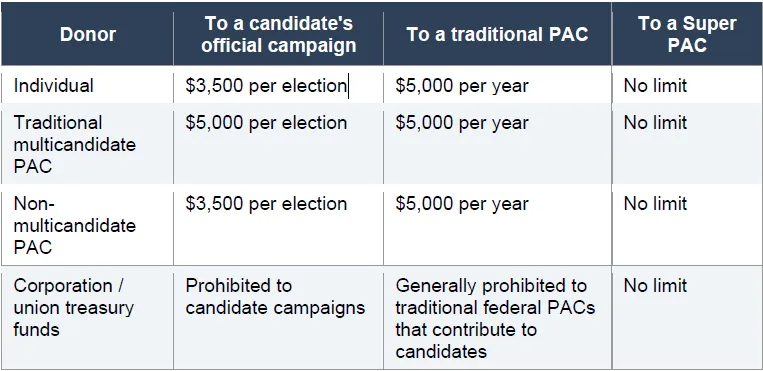
Supporters argue that political spending is political speech and that the government should not restrict speech based on the identity of the speaker. Those arguments deserve fair consideration. But critics are not wrong to see the danger. The issue is not whether people should be allowed to speak. The issue is whether unlimited political spending by concentrated wealth destroys the political equality democracy requires.
A billionaire buying millions of dollars in political ads is not simply speaking like an ordinary citizen. If one person can buy a microphone that drowns out millions of people, the formal right to speak remains, but the practical equality of citizenship is damaged.
Case Study: Crypto Super PACs and the 2024 Elections
The cryptocurrency industry offers a clear modern example. In 2024, major crypto companies poured enormous sums into Super PACs – primarily Fairshake, Protect Progress, and Defend American Jobs – supporting candidates viewed as friendly and opposing those viewed as skeptical of the industry.
One of the most revealing features: many ads did not even talk about cryptocurrency. They focused on ordinary campaign themes – jobs, families, the economy, character. Voters may not have realized they were watching ads funded by an industry seeking a more favorable regulatory environment. The public message was about the candidate. The underlying motive was about policy.
The pattern is clear: an industry faces regulation, funds outside political groups, those groups support friendly candidates, and the industry gains better access and softer regulation. That is not necessarily illegal. That is the point. A democracy can be distorted by conduct that is technically legal but structurally corrupting.
Citizens United also worsened the dark money problem. Money can move through nonprofits, shell organizations, and trade associations in ways that make it difficult for citizens to know who is really funding political messages. Democracy requires sunlight. Dark money turns off the lights.
Chapter 4: The Favor Economy
The more dangerous form of corruption is not the crude bribe. It is the favor economy – the network of benefits, relationships, rewards, and understandings that surround public power. It is not always illegal. It does not always involve an explicit deal. But it creates a culture in which powerful people help public officials gain office, remain in office, become wealthy, and enjoy privileges ordinary citizens never receive.
In return, those powerful people receive access, favorable policy, weak enforcement, government contracts, tax advantages, or simply a government that understands their interests first.
Case Study: Justice Thomas, Harlan Crow, and the Ethics of Wealthy Patronage
The relationship between Supreme Court Justice Clarence Thomas and billionaire Harlan Crow is one of the clearest modern examples. In 2023, ProPublica reported that Thomas had accepted luxury trips from Crow for more than two decades – private jet travel, yacht trips, and stays at Crow-connected properties – much of which had not appeared on Thomas’s public financial disclosures. Thomas said he understood the trips as personal hospitality from a close friend, but legal ethics experts disputed that interpretation.
A wealthy patron does not have to hand a justice a bribe. Lavish trips, private flights, resort stays, and long-term patronage create familiarity, gratitude, loyalty, and access. The standard should not be, “Can we prove an explicit corrupt bargain?” The standard for public office should be higher: Would a reasonable citizen wonder whether wealth has gained special access to public power?
Congress already recognizes this principle in its own ethics rules. Members of the House may generally accept a gift worth less than $50. Senate rules similarly limit gifts and prohibit most gifts from lobbyists or foreign agents. Those rules are not perfect, but the basic principle is sound. That principle should apply with even greater force to Supreme Court justices, who have lifetime tenure and enormous power over constitutional rights, corporate regulation, voting rights, and the limits of government itself.
The favor economy also includes personal enrichment through investment advice, real estate opportunities, private equity deals, favorable loans, or business relationships ordinary citizens could never obtain. Family members may receive jobs, consulting contracts, speaking invitations, or board seats. A public official does not have to receive money directly for the official’s household or network to benefit.
Public office must not be a gateway to private favors. It must be a commitment to public service.
Chapter 5: Public Office as a Wealth Machine
One of the most damaging questions citizens ask is also one of the most understandable: How do so many public officials become rich?
The suspicion is not irrational. When public officials make decisions affecting markets, industries, contracts, taxes, and regulations, it is natural to wonder whether they are using public knowledge and access for private gain. That suspicion grows when officials trade individual stocks, when their net worth increases dramatically, when family members receive unusual opportunities, and when officials receive gifts, speaking fees, or future employment from industries affected by their decisions.
Elected officials often know things before the public does. They receive briefings, meet with regulators, review legislation, understand which industries may be helped or harmed by upcoming decisions. Even when information is not classified, it may still be valuable. If an official can use that environment to trade stocks, move assets, or position investments, the public cannot trust that decisions are made solely for the common good.
Disclosure alone is not enough. Reporting a trade after the fact does not prevent the conflict of interest. The cleaner solution is to remove the temptation. Elected officials, cabinet members, senior regulators, judges, and top public servants should not trade individual stocks while in office. They should use genuine blind trusts, diversified mutual funds, or broad index funds.
Annual audits should be part of the answer. Every elected federal official and high-level public servant should undergo an independent annual financial integrity audit – reviewing income, assets, debts, gifts, loans, stock activity, business interests, real estate transactions, family-linked payments, and major changes in net worth.
The honor of public service should come from service itself, not from the private opportunities attached to power.
Chapter 6: The Revolving Door
A lawmaker leaves Congress and becomes a lobbyist. A regulator joins the industry they once regulated. A military official joins a defense contractor. A congressional staffer helps write legislation and then takes a high-paying job with a company that legislation affects.
This is usually defended as normal career movement. There is real truth in that – expertise developed in government is genuinely valuable. But the revolving door becomes dangerous when public service becomes a waiting room for private profit. If officials know that today’s decisions can lead to tomorrow’s job offers, then tomorrow’s job offers can influence today’s decisions.
The problem is not only that former officials lobby. The problem is that everyone still in office can see the path. They can see how power converts into money, how industry-friendly officials are rewarded, how aggressive regulators may be punished. The system teaches a lesson: be useful to powerful interests now, and you may be rewarded later.
The revolving door also weakens enforcement. Agencies may become hesitant to challenge industries that employ former colleagues or future employers. Regulators may begin to identify with the industries they oversee rather than the public they serve – this is what people mean by regulatory capture.
The solution is hard boundaries where conflicts are obvious: long cooling-off periods before former officials can lobby or consult for affected industries; rules that cover not just formal lobbying but also strategic advising, board service, and government relations work; required disclosure of employment negotiations while still in office; and meaningful penalties for violations.
A democracy cannot be healthy if public office becomes a temporary stop on the road to private wealth. Public service should not be a lobbyist training program. It should be a trust.
Chapter 7: Dark Money and the Disappearing Donor
Political money is dangerous enough when citizens can see it. It is even more dangerous when they cannot.
Dark money refers to political spending where the true source of funds is hidden – flowing through nonprofits, shell organizations, trade associations, or limited liability companies that obscure who is actually paying for political influence. The result: voters see the message, but not the sponsor.
In the 2024 federal elections, dark money reached a record level. The Brennan Center reported that dark money groups and shell companies poured more than $1.9 billion into the 2024 federal election cycle, nearly doubling the previous record from 2020. Since Citizens United, dark money groups have spent at least $4.3 billion on federal elections.
A group may have a patriotic name and claim to speak for families, workers, or taxpayers. But the money behind it may come from billionaires, corporations, or industry groups. The voter sees the ad and hears the claim, but may never know who paid for it or what they wanted in return.
Dark money also works with outside spending that is technically disclosed but still obscures the real issue at stake. Crypto-backed Super PACs in 2024 spent about $125 million in federal races while running ads that rarely mentioned cryptocurrency – focusing instead on biography, the economy, and other campaign themes. The public message was about character. The hidden motive was about regulation.
Dark money also increases cynicism. People begin to assume everything is secretly funded and secretly corrupt. That cynicism makes citizens less likely to trust honest institutions and less likely to participate in democracy.
The reform principle is straightforward: major political spending should be traceable to its true source. Any organization spending significant money to influence elections should disclose its major funders. Transfers between organizations should not be allowed to hide the original source. Disclosures should happen before elections, in searchable, readable formats that do not require detective work.
A democracy cannot survive when the people are governed by forces they cannot see.
Chapter 8: Why Ordinary People Lose Faith
When citizens believe the system is rigged, democracy begins to weaken from the inside.
People may not understand campaign finance law in detail, but they can sense when power is not working for them. They see politicians court donors while ordinary people struggle to get a response from an office. They see industries that caused harm receive bailouts or favorable legislation. They see wealthy people avoid consequences that would crush ordinary citizens. Over time, they draw a painful conclusion: the system is not really for us.
When ordinary people lose faith, they do not all respond the same way. Some disengage, concluding that participation is hopeless. Their withdrawal benefits the powerful because organized money has less resistance when ordinary citizens leave the field. Some become angry but unfocused, redirecting frustration toward scapegoats rather than concentrated wealth and political capture. Some become vulnerable to demagogues who attack corruption in language but use power for themselves and their allies.
This is one of the cruelest features of captured democracy: public anger at corruption can be used to deepen corruption.
Plutocracy thrives in cynicism. If everyone is assumed to be corrupt, actual corruption becomes easier to hide. If all sources are dismissed as equally dishonest, truthful reporting loses power. If legal processes are seen as partisan, accountability can be portrayed as persecution.
Trust cannot be restored by speeches. Officials cannot simply ask citizens to believe harder. Trust has to be earned through visible accountability, clean rules, real consequences, and public honesty. A democracy that asks for trust while tolerating obvious conflicts of interest is asking too much.
Reform must be framed not only as a legal project, but as a renewal of democratic self-respect. Citizens need to recover the belief that government belongs to them – not to billionaires, not to corporations, not to lobbyists, not to donors.
Chapter 9: The Anti-Plutocracy Reform Agenda
If plutocracy is the conversion of private wealth into public power, then reform must cut the pipelines between wealth and power.
The goal is not to punish success. It is not to silence business or prevent wealthy people from being citizens. The goal is simpler and more democratic: no one should be able to buy more citizenship than anyone else.
A serious anti-plutocracy reform agenda must address campaigns, dark money, lobbying, gifts, financial conflicts, stock trading, public enrichment, the revolving door, enforcement, and transparency. Reform cannot focus on one leak while leaving ten others open.
The First Reform: Limiting the Influence of Big Money in Elections
Direct campaign contributions should remain limited and enforced seriously. But reform must also address outside spending that functions as campaign support while hiding behind technical independence. Super PACs, dark money groups, corporate political spending, and donor networks can shape elections at massive scale. Coordination rules should be tightened. If a supposedly independent group is run by former campaign staff or exists primarily to support one candidate, the independence should be questioned.
The Second Reform: Public Financing of Elections
Qualified candidates should be able to run serious campaigns without spending their lives begging wealthy donors for money. Public financing can include matching small donations, democracy vouchers, grants for qualified candidates, free or reduced media access, and spending limits for candidates who accept public support. The purpose is to shift dependency: candidates should depend more on voters and less on the donor class. New York City’s small-donor matching program is one proven model that has demonstrated results at scale.
The Third Reform: Banning Dark Money
Any organization spending significant money to influence elections or major policy outcomes should disclose its major funders. Transfers between organizations should not be allowed to conceal the original source. Shell groups and donor-laundering arrangements should be exposed and penalized. Disclosure should happen before elections, not afterward. Citizens have a right to know who is trying to influence their vote.
The Fourth Reform: Banning Individual Stock Trading by Elected Officials
Members of Congress, presidents, vice presidents, cabinet officials, senior regulators, judges, and other high-level public officials should not trade individual stocks while in office. They should use blind trusts, broad index funds, diversified mutual funds, or similar arrangements that prevent targeted profit from public information and public decisions. This rule should extend, with appropriate safeguards, to spouses and dependent children when their trades create obvious conflicts.
The Fifth Reform: Annual Financial Integrity Audits
Every elected federal official and senior public servant should undergo an independent annual audit reviewing assets, income, debts, gifts, loans, stock activity, business interests, real estate transactions, outside compensation, family-linked payments, and major changes in net worth. The audit should be conducted by an independent ethics and financial integrity office with professional staff, legal authority, public reporting responsibilities, and protections from political retaliation.
The Sixth Reform: Banning Gifts, Luxury Travel, and Special Investment Opportunities
The standard should be simple: if a benefit is offered because of public office, the official should not accept it. That includes donor-funded vacations, private jet travel, luxury hospitality, below-market loans, debt forgiveness, free housing, special investment deals, and personal favors from people or entities seeking government action. The more power an official holds, the fewer private benefits they should be allowed to accept.
The Seventh Reform: Closing the Revolving Door
Former lawmakers, regulators, senior staffers, military leaders, judges, and cabinet officials should face long cooling-off periods before they can lobby, consult, advise, or receive compensation from industries or entities directly affected by their public responsibilities. The rules should cover not only registered lobbying, but also influence consulting, strategic advising, board service, and government relations work. Public officials should be required to disclose employment negotiations while in office and recuse themselves from decisions affecting potential future employers.
The Eighth Reform: Making Lobbying Transparent in Real Time
Lobbying is not inherently illegitimate – people and organizations have a right to petition government. But the public should know who is lobbying whom, on what issue, with what money, and for whose benefit. Meetings between lobbyists and elected officials or senior staff should be logged in a searchable public database. Major policy proposals influenced by outside groups should disclose the groups involved.
The Ninth Reform: Strengthening Ethics Enforcement
Ethics rules without enforcement are theater. Oversight bodies must be independent, well-funded, professionally staffed, and protected from retaliation. Inspectors general must be protected. Whistleblowers must be protected. Prosecutors must be able to pursue corruption without political interference. Congressional ethics offices must not be controlled by the very people they are supposed to investigate.
Penalties should be serious enough to deter abuse: fines, disgorgement of profits, loss of committee positions, loss of pension benefits for serious corruption, public censure, criminal referral, removal from office where appropriate, and bans on future lobbying or government contracting for severe violations.
The Tenth Reform: Creating a Public Integrity Dashboard
Every major public official should have a plain-language public profile showing campaign funding, major donors, outside spending supporting them, gifts, travel, assets, debts, stock holdings or blind trust status, outside income, lobbying contacts, family-linked financial interests, and changes in net worth.
This information should not be hidden in scattered filings and unreadable databases. It should be searchable, understandable, and accessible to ordinary citizens. Democracy should not require citizens to become investigators just to understand who may be influencing their government.
The Eleventh Reform: Protecting Voting Rights and Representation
Anti-plutocracy reform must include the political power of ordinary citizens. That means protecting the right to vote, preventing voter suppression, ending extreme gerrymandering, strengthening election administration, supporting independent redistricting, and making representation more responsive to the public. Money in politics is not the only way democracy is weakened. If voters are blocked, diluted, discouraged, or manipulated, plutocratic power becomes even harder to challenge.
The Twelfth Reform: Civic Renewal
Laws matter, but culture matters too. Citizens need better civic education, stronger local journalism, more transparent public meetings, easier access to government information, and a renewed expectation that public service is a duty rather than a celebrity platform or wealth strategy.
The anti-plutocracy agenda is not radical in its moral premise. It is basic democratic hygiene.
Clean elections. Transparent money. No insider trading. No secret gifts. No donor favors. No hidden influence. No revolving-door payoffs. No public office as private enrichment. Real enforcement. Public accountability.
These should not be extreme demands. They should be the minimum standards of a self-respecting republic.
Chapter 10: The Moral Argument
The fight against plutocracy is not only a policy debate. It is a moral argument about human worth.
Democracy rests on a radical claim: every person matters. Not equally in wealth, fame, or status – but equally in civic dignity. Every citizen has a claim on the government because the government belongs to the people. Plutocracy violates that claim. It says, in practice, that wealth matters more than citizenship. It says the person who can fund campaigns deserves more access than the person working two jobs. It says the billionaire’s preferences carry more weight than the votes and voices of millions of ordinary people.
The moral injury of plutocracy is that it teaches people they are lesser citizens. Over time, people become cynical, angry, and numb. They stop expecting decency from public life. They stop believing their participation has meaning. That is a tragedy, because democracy depends on citizens who still believe they have agency.
This is why restoring democracy is not only about changing laws. It is about restoring dignity. Citizens should not have to beg for a government that hears them. They should not have to compete with billionaires for the attention of their own representatives.
It is not naïve to believe public office should be honorable. It is not naïve to believe citizens should matter more than donors. It is not naïve to believe laws should be written for public reasons. What is naïve is thinking democracy can survive indefinitely while wealth buys more and more control over it.
A society can honor success without allowing success to become domination. A society can include wealthy citizens without becoming a government of the wealthy, by the wealthy, and for the wealthy. The fight against plutocracy is not a fight against wealth itself. It is a fight against the misuse of wealth to overpower democracy.
The moral center of democracy is shared responsibility. We govern ourselves together because we are bound together – not equally rich, not equally powerful, not equally fortunate, but equally human. When plutocracy rises, that shared responsibility is replaced by hierarchy.
The moral argument is not complicated: public power belongs to the public. Public office is a trust. Citizenship should not be for sale. Wealth must not outrank human worth.
Conclusion: Democracy Is Not Self-Executing
Democracy does not protect itself. It must be protected by its citizens.
Many assume that once a country has a constitution, elections, courts, and representative institutions, democracy becomes permanent. But history does not support that comfort. The danger is not always dramatic. It is not always a coup or soldiers in the streets. Sometimes the danger is quieter: the steady normalization of a system in which wealth buys access, access shapes policy, policy creates profit, and profit buys more power.
The United States is not beyond repair. Ordinary people still vote. Public pressure still changes outcomes. Journalists still expose wrongdoing. Courts still matter. Whistleblowers still come forward. Citizens still have power when they organize and refuse to surrender.
But repair requires honesty. We cannot repair democracy by pretending that money has not distorted it. We cannot restore trust by asking citizens to ignore conflicts of interest. We cannot celebrate freedom while allowing hidden money, donor access, lobbying power, and revolving-door rewards to shape decisions behind the scenes.
A democracy worthy of the name must be able to govern itself in public, for public reasons, under public accountability.
The standard is not perfection. The standard is whether democracy can defend itself against capture. Whether public office remains a public trust. Whether citizenship matters more than money.
We can continue treating corruption as a series of isolated scandals, each one shocking for a moment and then forgotten. Or we can recognize the deeper system that makes those scandals predictable. If we treat corruption only as a scandal, we will chase symptoms forever. If we treat corruption as a system, we can begin to change the system.
The work will not be easy. The people and institutions benefiting from plutocratic capture will not give up influence politely. But democracy has always required courage. It requires citizens who are willing to see clearly, speak plainly, organize patiently, demand accountability, and insist that public power belongs to the public.
At its core, this is a fight for the dignity of citizenship. Every citizen should be able to believe that their voice matters, that laws are written for public reasons, that officials serve the country and not donors, and that public office is not for sale.
That belief will not return because leaders tell us to trust them.
It will return when the rules prove it.
Democracy is not self-executing. It survives only when citizens defend it, institutions protect it, and public power is held accountable to the people from whom it comes.
If we want a government of the people, by the people, and for the people, we have to build a system where money cannot quietly become the people.
About the Author
Paul Hoyt has over 60 years of business experience and has been a Business Consultant and Business Coach for the past 25 years. He has worked with hundreds of business owners and trained thousands more across many industries, from startups to $30 million USD in annual revenues.
After a 30-year career in Information Systems, serving in the roles of Programmer, Systems Analyst, Team Leader, Database Administrator, CIO, VP of Professional Services, Enterprise Project Manager, and Business Owner, Paul became a Business Consultant in 2001, leveraging his broad experience across many industries and all departments within companies large and small.

He is also a passionate Personal Coach, having been doing his inner work for 60 years. Paul is the creator of Mind Sequencing, a personal development system that leverages the incredible power of our inner monologue, and the founder of The Focused Mind Community and The GoodPower Project.
You can learn more about him at www.PaulHoyt.com, www.MindSequencing.com, and www.GoodPowerProject.com
About the Author
Paul Hoyt has over 60 years of business experience and has been a Business Consultant and Business Coach for the past 25 years. He has worked with hundreds of business owners and trained thousands more across many industries, from startups to $30 million USD in annual revenues.
After a 30-year career in Information Systems, serving in the roles of Programmer, Systems Analyst, Team Leader, Database Administrator, CIO, VP of Professional Services, Enterprise Project Manager, and Business Owner, Paul became a Business Consultant in 2001, leveraging his broad experience across many industries and all departments within companies large and small.
He is also a passionate Personal Coach, having been doing his inner work for 60 years. Paul is the creator of Mind Sequencing, a personal development system that leverages the incredible power of our inner monologue, and the founder of The Focused Mind Community and The GoodPower Project.
You can learn more about him at www.PaulHoyt.com, www.MindSequencing.com, and www.GoodPowerProject.com
Sources and Endnotes
These notes support the main factual claims and case studies in this paper. They are not exhaustive legal citations, but they provide a strong factual foundation and point readers to primary or reputable sources.
[1] Encyclopedia Britannica defines democracy as a system in which power is vested in the people and exercised directly or through freely elected representatives. https://www.britannica.com/topic/democracy
[2] Encyclopedia Britannica defines oligarchy as government by the few; oligarchies in which the ruling group is wealthy are known as plutocracies. https://www.britannica.com/topic/oligarchy
[3] Buckley v. Valeo (1976) upheld limits on direct campaign contributions but struck down limits on independent expenditures. https://www.fec.gov/legal-resources/court-cases/buckley-v-valeo/
[4] Citizens United v. FEC (2010) struck down restrictions on independent expenditures by corporations and unions. https://www.fec.gov/legal-resources/court-cases/citizens-united-v-fec/
[5] SpeechNow.org v. FEC (2010) held that limits on contributions to independent-expenditure-only committees violated the First Amendment, helping create the modern Super PAC structure. https://www.fec.gov/legal-resources/court-cases/speechnoworg-v-fec/
[6] FEC explanation of independent expenditures. https://www.fec.gov/help-candidates-and-committees/making-independent-expenditures/
[7] Public Citizen reported in August 2024 that crypto-sector corporations had put more than $119 million into the 2024 elections. https://www.citizen.org/article/big-crypto-big-spending-2024/
[8] Politico reported that Fairshake, Protect Progress, and Defend American Jobs spent about $125 million in federal races, with many ads not mentioning cryptocurrency. https://www.politico.com/news/2024/10/15/crypto-election-ads-fairshake-00183700
[9] ProPublica reported that Justice Clarence Thomas had accepted luxury trips from Harlan Crow for more than two decades. https://www.propublica.org/article/clarence-thomas-scotus-undisclosed-luxury-travel-gifts-crow
[10] ProPublica on Thomas’s explanation and legal experts’ response. https://www.propublica.org/article/clarence-thomas-response-trips-legal-experts-harlan-crow
[11] House Committee on Ethics gift rules. https://ethics.house.gov/manual/exceptions-to-the-gift-rule-for-permissible-gifts/gifts-worth-less-than-50/
[12] U.S. Senate Select Committee on Ethics gift guidance. https://www.ethics.senate.gov/public/index.cfm/gifts
[13] Reuters reported the Supreme Court’s first formal code of conduct in November 2023, noting it lacked an outside enforcement mechanism. https://www.reuters.com/legal/us-supreme-court-announces-formal-ethics-code-justices-2023-11-13/
[14] Brennan Center on congressional stock trading. https://www.brennancenter.org/our-work/research-reports/congressional-stock-trading-explained
[15] Federal post-employment restrictions under 18 U.S.C. § 207. https://uscode.house.gov/view.xhtml?req=granuleid:USC-prelim-title18-section207
[16] Brennan Center: dark money reached a record $1.9 billion in the 2024 federal election cycle. https://www.brennancenter.org/our-work/research-reports/dark-money-hit-record-high-19-billion-2024-federal-races
[17] Axios reported that a review of 59 ads funded by crypto-backed PACs found none mentioned blockchain or cryptocurrency. https://www.axios.com/2024/10/29/crypto-election-ad-spend-fairshake-pac
[18] ABC News/538 on pro-Israel groups and 2024 Democratic primaries. https://abcnews.com/538/pro-israel-groups-spent-big-oust-squad-members/story?id=113675889
[19] Pew Research Center on long-term low levels of public trust in the federal government. https://www.pewresearch.org/politics/2025/12/04/public-trust-in-government-1958-2025/
[20] Brennan Center on small-donor public financing. https://www.brennancenter.org/our-work/research-reports/small-donor-public-financing-explained
[21] CRS summary on executive branch post-employment restrictions. https://www.everycrsreport.com/files/20161215_IN10625_f44ef7b87f915c4fb4759dd1635967d824d5a67d.html